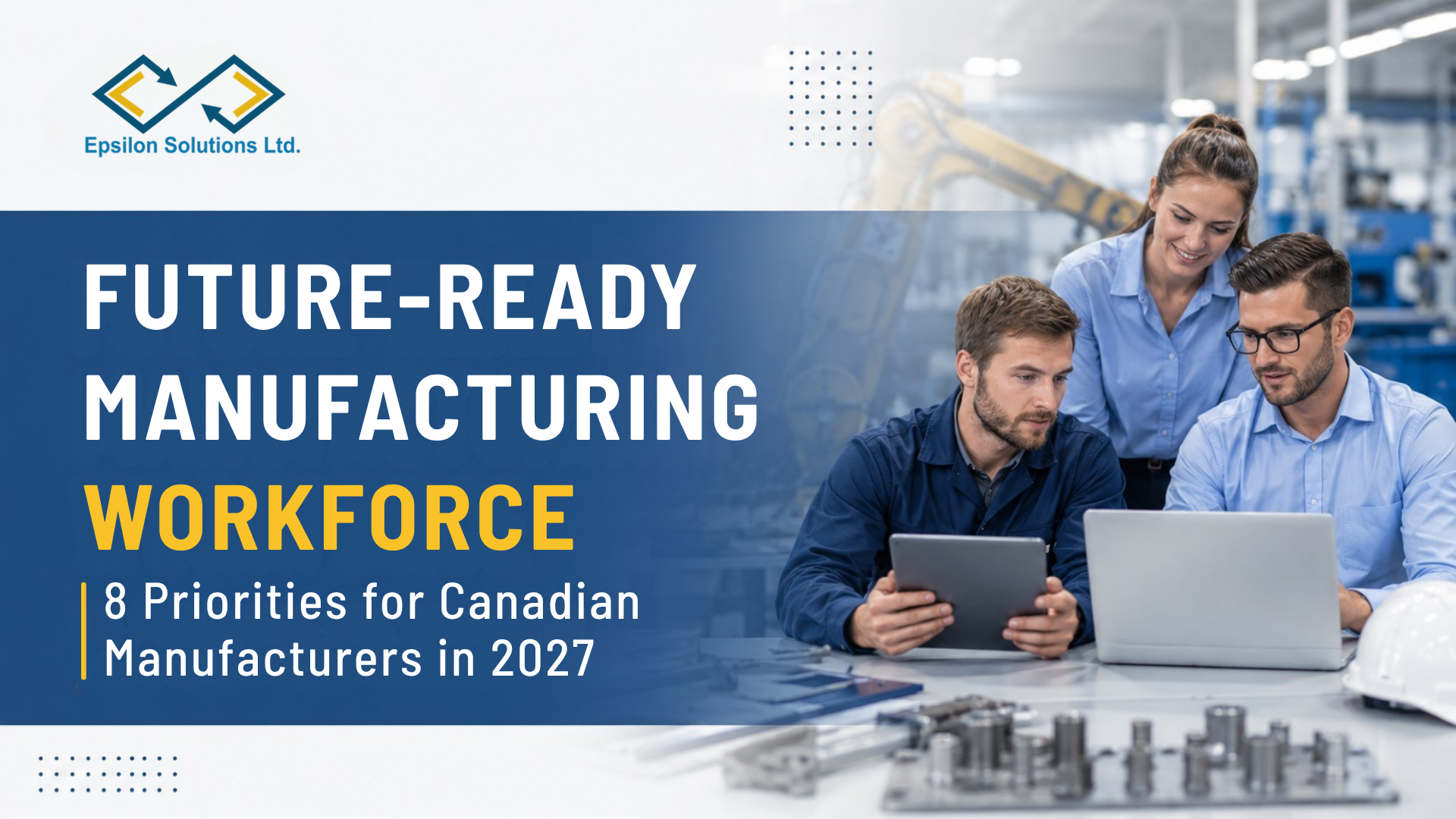
Canadian manufacturing is entering a period in which workforce capability will matter as much as production capacity.
Manufacturers are adopting automation, artificial intelligence, connected systems and data-led processes while also managing supply-chain uncertainty, changing customer expectations, retirement-driven knowledge loss and continued difficulty accessing specialized talent.
These pressures are changing the nature of the workforce challenge.
The question is no longer simply whether enough candidates are available. It is whether manufacturers can access, develop and retain the technical, digital and operational capabilities required to support increasingly connected production environments.
Statistics Canada reported that 35.1% of Canadian businesses experienced difficulty finding candidates with the skills required for available roles during the previous 12 months. It also found that technical, practical and job-specific skills represented one of the most important areas for workforce improvement.
As manufacturers prepare for 2027, workforce planning will need to become more proactive, skills-led, flexible and closely connected to technology and operational strategy.
Here are eight priorities that can help Canadian manufacturers build a workforce ready for what comes next.
1. Define Future Skills Before Hiring Becomes Urgent
Traditional workforce planning often begins after a position becomes vacant or a new project is approved.
By that point, the organization may already be competing for scarce talent under tight delivery timelines.
Manufacturers need to identify future-critical capabilities before vacancies emerge. Depending on their operations and transformation plans, these may include:
- Industrial automation support
- Data engineering and analytics
- AI-enabled operations
- Cloud-connected production environments
- Enterprise application support
- Cybersecurity for connected infrastructure
- Digital supply-chain operations
- Quality and process digitization
- Technology-enabled maintenance
- Business systems integration
A manufacturer may receive a large number of applications and still be unable to find candidates who understand both the technology and the operational environment in which it will be used.
This is a skills-alignment problem, not simply a candidate-volume problem.
What manufacturers should prioritize
Roles should be defined around required capabilities and expected outcomes rather than job titles and years of experience alone.
For every critical position, manufacturers should determine:
- Which capabilities are essential from the first day
- Which skills can be developed after hiring
- Which adjacent skills indicate learning potential
- Which responsibilities must remain onsite
- Which work can be supported remotely
- Which roles could be prepared through structured training
- Which capabilities could be delivered through flexible or nearshore teams
This approach can expand the available talent pipeline without compromising workforce readiness.
2. Connect Automation Investment With Workforce Readiness
Automation is often discussed as a way to reduce workforce dependence. In practice, it usually changes the type of workforce an organization needs.
Automated and connected manufacturing environments still require professionals who can:
- Configure and monitor systems
- Interpret operational data
- Maintain digital workflows
- Integrate platforms
- Investigate exceptions
- Troubleshoot technology
- Protect connected infrastructure
- Improve processes continuously
The future manufacturing workforce will not be defined by people or technology alone. It will be shaped by how effectively manufacturers combine the two.
Statistics Canada found that 47.9% of Canadian businesses had adopted new technologies during the previous three years. Among those businesses, 85.7% provided training to support employees with technology adoption.
Technology implementation does not automatically create operational capability. Employees must be prepared to use, manage and improve the systems being introduced.
What manufacturers should prioritize
Every significant automation, AI or digital-transformation initiative should include:
- A workforce-readiness assessment
- Identification of roles that will change
- A plan for hiring specialized capabilities
- Reskilling pathways for existing employees
- Role-specific training requirements
- Human oversight and accountability
- Post-deployment support requirements
- Continuous upskilling as technologies evolve
Technology and workforce planning should be developed as connected workstreams.
3. Protect Institutional Knowledge Before It Leaves
Retirement and turnover do not only reduce headcount. They can remove decades of operational knowledge that may never have been formally documented.
Experienced employees often understand:
- Equipment behaviour
- Historical maintenance issues
- Production exceptions
- Supplier dependencies
- Quality risks
- Customer-specific requirements
- Informal troubleshooting methods
- Workarounds within legacy systems
- The reasoning behind established processes
When this knowledge leaves unexpectedly, new employees may require significantly more time to become productive.
The risk becomes even greater during modernization programs. Technology teams may understand the new platform but lack the operational context held by experienced employees.
Canada’s 2026–2030 Sustainable Jobs Action Plan identifies increasing retirements, skills mismatches, automation and AI among the forces changing labour and skills demand across the country.
What manufacturers should prioritize
Knowledge transfer should be treated as a formal workforce initiative rather than an informal handover completed during an employee’s final weeks.
Manufacturers can:
- Identify roles with high retirement or succession exposure
- Document critical processes and decision points
- Record common exceptions and troubleshooting methods
- Pair experienced employees with developing talent
- Convert operational knowledge into learning modules
- Build succession and skills-readiness assessments
- Develop replacement pipelines before vacancies become urgent
Structured training and mentorship can help convert individual experience into long-term organizational capability.
4. Make Role-Based Upskilling a Core Talent Strategy
Manufacturers cannot depend exclusively on recruiting candidates who already possess every required skill.
Technology is changing quickly, and many organizations are competing for the same limited pools of automation, data, AI, cloud and digital-operations talent.
Existing employees often have valuable advantages over external candidates. They already understand the organization’s products, production processes, safety expectations, customers and working environment.
The opportunity is to identify where those existing capabilities can be expanded.
Examples include:
- Production professionals developing digital-operations skills
- Analysts learning AI-enabled reporting and forecasting
- Application-support teams gaining manufacturing-platform expertise
- Quality professionals developing data-visualization capabilities
- Technical employees preparing for automation-support roles
- Operational leaders building AI literacy and governance skills
What manufacturers should prioritize
Upskilling should be connected to a defined role or operational requirement.
A structured program should include:
- A clearly identified workforce need
- An assessment of current capabilities
- Identification of the specific skills gap
- Role-based technical and functional training
- Practical exercises connected to the work environment
- Readiness evaluation before deployment
- Continued learning after the employee enters the role
Generic learning programs can increase awareness. Role-based programs are more likely to improve workforce readiness and time to productivity.
5. Build the Right Mix of Permanent and Flexible Capacity
Manufacturing workforce requirements can change quickly because of:
- New customer programs
- Seasonal demand
- Order-volume fluctuations
- Product launches
- Plant modernization
- Enterprise-platform implementations
- Supply-chain disruption
- Automation projects
- Data and AI initiatives
- Temporary capability gaps
A completely fixed workforce can limit flexibility. An excessively temporary model can weaken continuity, accountability and institutional knowledge.
A stronger approach is to create a deliberate workforce model combining:
- A permanent core workforce
- Specialized contract professionals
- Project-based technology talent
- Trained talent pipelines
- Domestic delivery teams
- North America-aligned nearshore capacity
- Managed support functions
- Dedicated delivery centres
What manufacturers should prioritize
The workforce model should reflect the nature, location and expected duration of the work.
Permanent employees may remain appropriate for responsibilities requiring deep institutional knowledge, long-term ownership or continuous onsite presence.
Flexible and nearshore professionals may support:
- Digital-transformation programs
- Data and analytics
- Application modernization
- Enterprise-platform support
- Automation initiatives
- Testing and quality assurance
- Cloud operations
- Technology support
- Time-bound modernization projects
The objective is not simply to add people quickly. It is to create capacity that remains aligned with delivery requirements, governance and business continuity.
6. Use Nearshore Delivery as a Workforce Resilience Strategy
Nearshore delivery should not be evaluated only as a cost-saving model.
For Canadian manufacturers, domestic Canadian teams and North America-aligned nearshore capacity can provide access to specialized talent while supporting closer time-zone alignment, communication, governance and operational integration.
Nearshore teams can support functions such as:
- Application and platform operations
- Data engineering and analytics
- Cloud support
- AI enablement
- Automation-support functions
- Quality assurance
- Digital supply-chain initiatives
- Technology operations
- Business-process support
Nearshore delivery can also provide a structured path for launching a new capability without immediately building every recruitment, training, HR and management function internally.
What manufacturers should prioritize
Nearshore partners should be assessed across more than hourly rates.
Important considerations include:
- Relevant skills and domain understanding
- Time-zone overlap
- Communication standards
- Data and security requirements
- Workforce governance
- Training capability
- Employee retention
- Scalability
- Performance management
- Transition planning
- Long-term operational ownership
A well-designed nearshore team should operate as an extension of the manufacturer’s organization rather than as an isolated external resource pool.
7. Move From Transactional Recruitment to Talent Enablement
Traditional recruitment usually begins after a requisition is approved and ends when a candidate accepts an offer.
That model becomes less effective when specialized skills are scarce, technologies change quickly and workforce demand moves across locations, projects or business units.
Manufacturers increasingly need support across a broader talent lifecycle, including:
- Workforce planning
- Talent mapping
- Candidate sourcing
- Skills-based screening
- Role-specific assessment
- Training and upskilling
- Hiring coordination
- Onboarding
- Deployment
- Retention support
- Performance reporting
- Workforce governance
Recruitment Process Outsourcing can help manufacturers create more consistent and scalable hiring processes, particularly when requirements span multiple locations, technologies or business units.
What manufacturers should prioritize
Recruitment performance should be evaluated using more than time-to-fill.
Useful measures include:
- Candidate-to-interview conversion
- Interview-to-offer conversion
- Offer acceptance
- Skills-readiness levels
- Deployment readiness
- Hiring-manager satisfaction
- Time to productivity
- Retention
- Quality of hire
The objective should be to create a repeatable talent engine rather than restarting the recruitment process for every new requirement.
8. Make Workforce Readiness an Operational Metric
Workforce planning can no longer remain separate from production, technology and capital planning.
A new automated line, enterprise platform, digital program or expansion initiative cannot deliver its intended value unless the organization has people who can operate, maintain and improve it.
Manufacturing leaders therefore need visibility into:
- Critical skill gaps
- Retirement and succession exposure
- Recruitment lead times
- Training readiness
- Contractor dependency
- Attrition by role
- Workforce costs
- Delivery capacity
- Knowledge concentration
- Time to productivity
Workforce indicators should be reviewed alongside operational and financial measures.
What manufacturers should prioritize
Leadership teams should be able to answer questions such as:
- Does a planned transformation have the skills required to launch?
- Does a critical operation depend on one or two employees?
- Could recruitment timelines delay implementation or production?
- Will new technology require capabilities that are not currently available?
- Could structured training close the gap faster than external recruitment?
- Could flexible capacity reduce delivery risk?
- Is there a transition plan for every business-critical role?
Workforce readiness should be assessed before major investments are finalized—not after systems, equipment or customer commitments are already in place.
Preparing Canadian Manufacturing for 2027
Canadian manufacturing is not facing one universal labour shortage.
It is managing a combination of specialized skills gaps, knowledge-transfer risks, technology transitions, changing workforce expectations and fluctuating demand.
The manufacturers best positioned for 2027 will build workforce strategies around capability rather than headcount alone.
That means:
- Defining future skills before vacancies emerge
- Connecting technology investments with workforce development
- Protecting institutional knowledge
- Creating role-based upskilling pathways
- Combining permanent and flexible workforce capacity
- Using nearshore delivery strategically
- Building proactive talent pipelines
- Treating workforce readiness as an operational measure
How Epsilon Solutions Ltd. Supports Manufacturing Workforce Transformation
Epsilon Solutions Ltd. helps enterprises build, scale and upskill nearshore teams through workforce expertise, AI-led training and structured delivery models.
Its workforce approach covers hiring, training, reskilling, deployment, governance, retention and managed operations. Epsilon Solutions Ltd. current service portfolio includes Nearshore Workforce Solutions, AI Workforce Enablement, Train-to-Hire, Train & Deploy, BOT and Delivery Centres, Specialized AI Operations Teams and Recruitment Process Outsourcing.
For manufacturing organizations, Epsilon Solutions Ltd. can support:
Staff Augmentation and Direct Hire
Access specialized technology, digital-operations, automation-support and transformation talent for project-based or long-term workforce requirements.
Recruitment Process Outsourcing
Build consistent and scalable recruitment processes supported by sourcing, screening, assessment, hiring coordination, reporting and delivery governance.
Train-to-Hire
Create customized talent pipelines trained around specific technologies, roles and business requirements before hiring.
Train & Deploy
Deploy project-ready professionals who have completed role-based technical, functional and AI-readiness training before onboarding.
AI Workforce Enablement
Prepare existing and new employees for AI-enhanced workflows, automation, cloud platforms, data-led operations and digital transformation.
Nearshore Workforce Solutions
Build and manage scalable nearshore teams with structured hiring, HR support, compliance, retention and workforce governance.
Build-Operate-Transfer and Delivery Centres
Establish and operate a dedicated delivery capability before transitioning the team and operating structure to the client.
Epsilon Solutions Ltd Hire–Train–Deploy and continuous-upskilling model is designed to help organizations build talent that is prepared, productive and able to grow with changing business requirements.
The Next Workforce Question
The workforce decisions manufacturers make today will influence how effectively they can modernize, scale and respond to change through 2027.
The question is no longer only:
How many people do we need?
It is:
What capabilities will our operations require, how quickly can we build them and which workforce model will deliver them most effectively?
Epsilon Solutions Ltd helps manufacturing organizations build the skills, teams and delivery structures required for the next phase of digital and operational growth.